
CERN and Mistral announced a statement of intent on Thursday, October 15, to develop artificial intelligence for particle physics. According to the laboratory’s announcement, the project envisages a model trained on billions of simulated proton collisions at the Large Hadron Collider (LHC).
One AI model for different research stages
The proposal brings together tasks such as identifying particles, reconstructing collisions and flagging unexpected signals. Reuters reported that the model has been named Flare and that no budget or delivery timetable was disclosed.
The announcement therefore describes a development project, not the discovery of new particles or a system already available for general use.
What is the LHC?
The accelerator occupies a 27-kilometre underground ring on the French-Swiss border. Beams travel in opposite directions before being brought into collision. Detectors such as ATLAS, CMS, ALICE and LHCb record the products of these encounters for studies of the structure of matter.
This context helps explain the difference between the project and a conversational assistant: its central input is information about collisions, rather than requests to write texts. A tool that identifies an interesting pattern remains an instrument of investigation; it does not, on its own, amount to proof of a scientific hypothesis.
Sources and image
Reporting sources: CERN’s October 15 announcement, Reuters reporting and official LHC documentation.
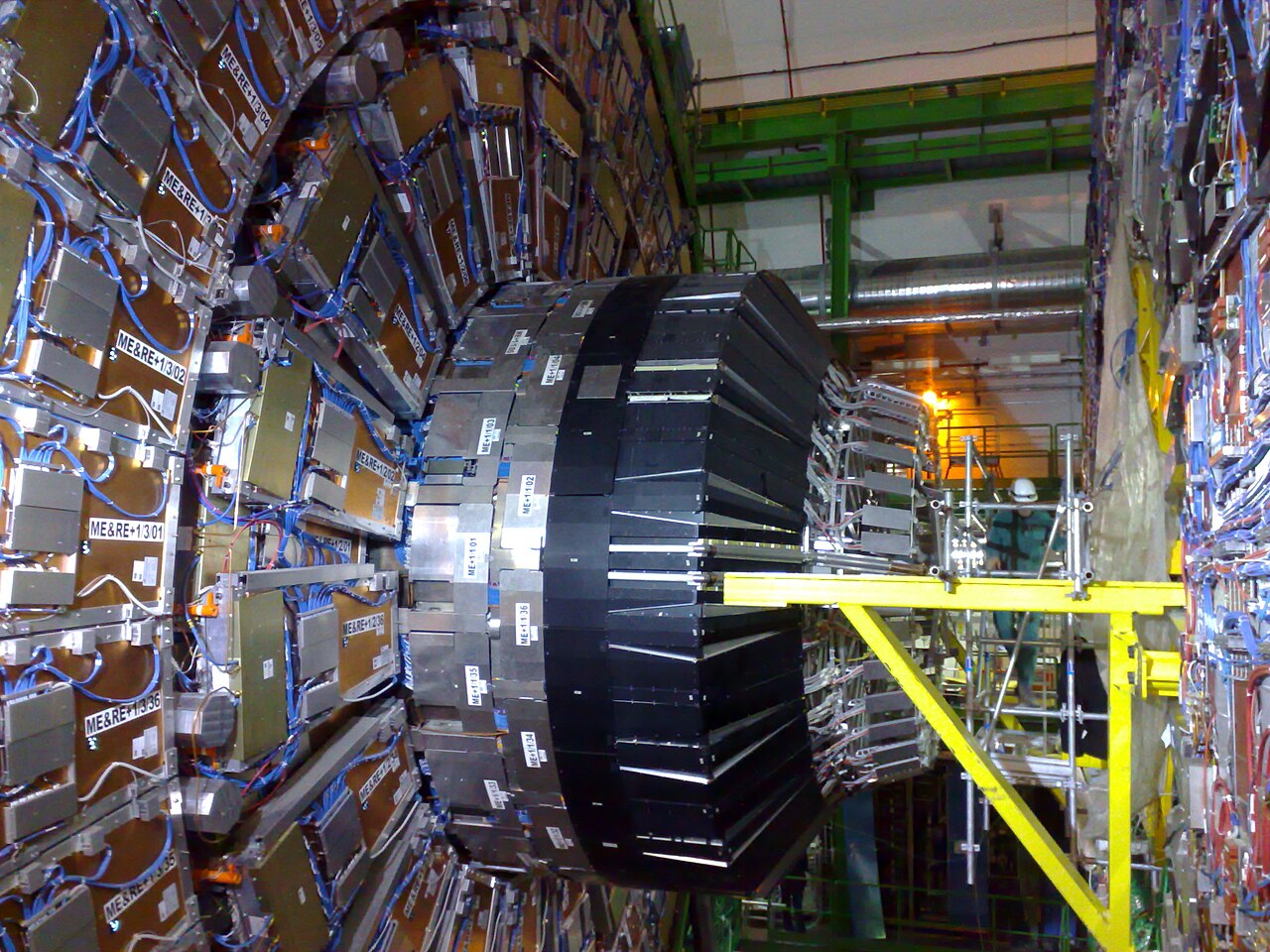
Archive image: the CMS detector on March 7, 2008. Photo: zipckr, via Wikimedia Commons, licensed under CC BY 2.0. Image resized; it does not depict the new AI model.