

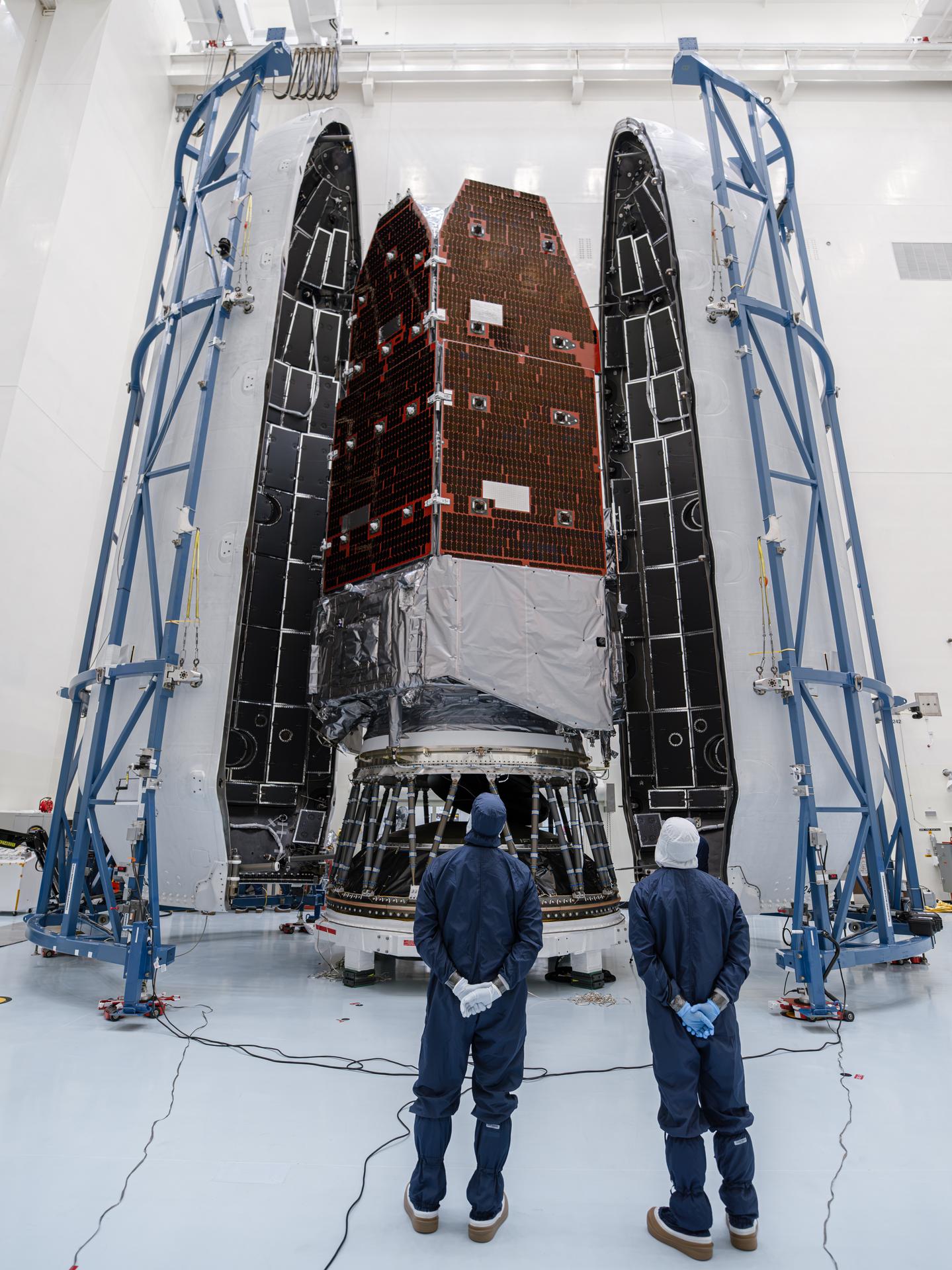
The Nancy Grace Roman Space Telescope arrived at Launch Complex 39A at Kennedy Space Center, Florida, for the final preparation phase. NASA and SpaceX scheduled liftoff on a Falcon Heavy rocket for August 30, 2026, at 7:26 a.m. Eastern Time, subject to technical and weather conditions.
The observatory was encapsulated in the rocket’s payload fairing and transported to the pad. Following launch and separation, it will head to the Sun–Earth Lagrange point L2, located approximately 1.6 million kilometers from the planet.
A much larger field of view
The Roman will have a resolution comparable to that of the Hubble space telescope, but will observe an area of the sky at least one hundred times larger in each exposure. This combination will make it possible to map billions of galaxies and produce wide surveys of the Universe with a high level of detail.
Among the main objectives are investigating the accelerated expansion of the Universe, studying dark energy and dark matter, detecting exoplanets through gravitational microlensing, and observing black holes and Solar System objects.
Coronagraph will demonstrate new technology
In addition to the wide-field instrument, the mission carries a coronagraph developed to block direct light from stars and reveal much fainter objects around them. The technology will serve as a demonstration for future observatories capable of photographing Earth-like planets.
Open data for the scientific community
The primary mission is expected to last five years, with an operational goal of ten. After processing, the data will be made publicly available, allowing researchers from different countries to conduct studies beyond the programs initially planned.
The official broadcast of the launch and prior activities will be provided on NASA channels. The time may be updated if teams identify a technical need or changes in weather conditions.
Sources: NASA and official Roman mission page.