
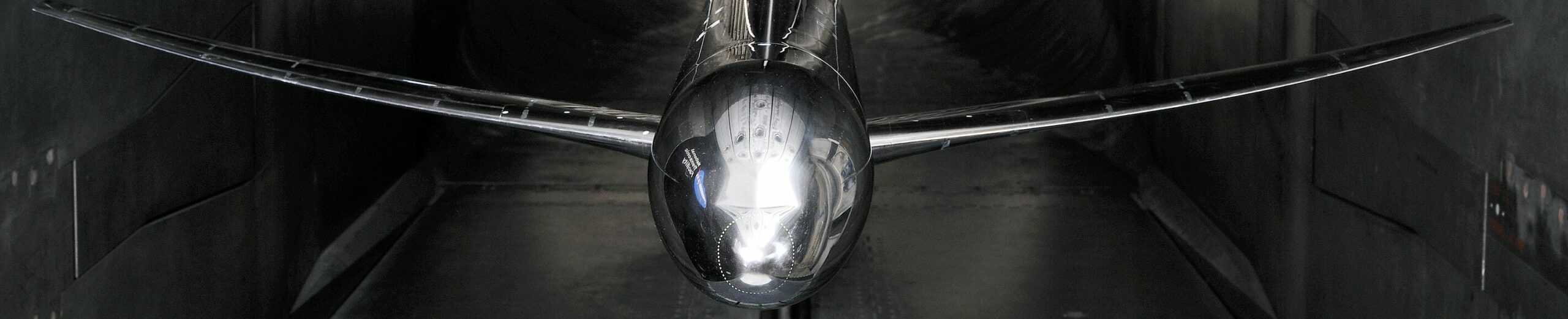
The National Aeronautics and Space Administration of the United States (NASA) provides an essential technical collection for the advancement of global aerospace engineering: the scientific publications of the High Lift Common Research Model (CRM-HL). This common research model for high-lift systems is a crucial tool for studying the aerodynamics of transonic transport aircraft, especially during the critical takeoff and landing phases.
Although the specific CRM-HL portal is currently undergoing updates and under construction, the space agency maintains public access to key papers and reports that lay the foundation for the project. The initiative is part of NASA’s ongoing effort to explore the unknown in air and space, innovating for the benefit of humanity and sharing scientific data with the global community of researchers and engineers.
What is the High Lift Common Research Model (CRM-HL)?
The CRM-HL is an aerodynamic configuration representative of modern transonic transport aircraft equipped with high-lift devices (such as flaps and slats). The development and standardization of this model allow different research institutions, universities, and aerospace industries to compare experimental and computational data in a standardized manner.
The historical and technical evolution of the model is recorded in benchmark publications of the American Institute of Aeronautics and Astronautics (AIAA). Among the fundamental documents confirmed by the agency, the following stand out:
- AIAA-2016-0308: Development of the High Lift Common Research Model (HL-CRM): A Representative High Lift Configuration for Transonic Transports. This work documents the initial creation of the representative model.
- AIAA 2020-2771: Definition of Initial Landing and Takeoff Reference Configurations for the High Lift Common Research Model (CRM-HL). This document establishes reference configurations for landing and takeoff simulations.
Wind Tunnel Testing and Experimental Validation
To ensure the accuracy of mathematical models and digital simulations, NASA and its international partners performed extensive physical tests in pressurized low-speed wind tunnels. These tests provide high-fidelity empirical data on airflow behavior under conditions simulating real approach and climb flight.
The results of these practical tests are detailed in two main publications within the CRM-HL ecosystem:
- AIAA 2020-2770: Reports a summary of tests conducted with the half-span (Half-Span) model version in the QinetiQ 5-Metre Pressurized Low-Speed Wind Tunnel (QinetiQ 5-Metre Pressurized Low-Speed Wind Tunnel).
- AIAA 2023-0823: Presents a summary of tests with the full-span (Full-Span) model conducted in the ONERA F1 Pressurized Low-Speed Wind Tunnel (ONERA F1 Pressurized Low-Speed Wind Tunnel) in France.
These experimental tests are of utmost importance for validating Computational Fluid Dynamics (CFD) tools, making it possible to identify discrepancies between theoretical predictions and the aircraft’s actual physical behavior.
Challenges in Computational Fluid Dynamics (CFD)
Digital simulation of airflow around complex geometries, such as wings equipped with deployed flaps and slats, represents one of the greatest challenges in modern aerodynamics. Publication AIAA 2020-2772, titled Requirements and Challenges for CFD Validation within the High-Lift Common Research Model Ecosystem, specifically addresses the technical requirements and obstacles faced by researchers in validating CFD codes within the CRM-HL ecosystem.
Accurate validation of these computational models is essential to reducing development costs for new commercial aircraft, making them more efficient, quieter, and safer.
Connection with Swept-Wing Icing Research
Within the scope of NASA’s Common Research Model portal, the integration with research focused on operational safety in adverse weather conditions is also highlighted. The system’s navigation menu points to a direct correlation with Swept-Wing Icing Research and the Ice Accretion Database.
Ice accretion on aerodynamic surfaces, especially on swept wings equipped with high-lift devices, can drastically alter the airflow profile, leading to premature loss of lift (stall) and reduced aircraft control. The data generated by the CRM-HL and ice accretion studies provide scientific input to mitigate these risks, ensuring that de-icing systems and performance prediction models are tested under rigorous, standardized parameters.
Portal Status and Guidance for Researchers
NASA informs that the specific CRM-HL publications page is temporarily under construction. To obtain the latest and most complete information about the model, users and researchers should consult the main NASA Common Research Model website.
The last recorded update to the portal occurred on August 28, 2026, edited by mpritter and supervised by responsible NASA official Abigail Bowman. The transparency in making these data available reinforces the agency’s role as a pillar supporting technological innovation and international civil aviation safety.
Sources consulted
- NASA Common Research Model – CRM-HL Publications. Available at: https://www.nasa.gov/common_research_model/crm-hl/publications/. Accessed in: 2026.