
Autonomous vehicles are changing the way scientists observe Earth’s most challenging environments. Robotic submarines, drones, and small uncrewed vessels can already work for months in Antarctica, the Arctic, and sub-Antarctic islands, reaching locations that are too dangerous or distant for human teams.
Science under the ice and near glaciers
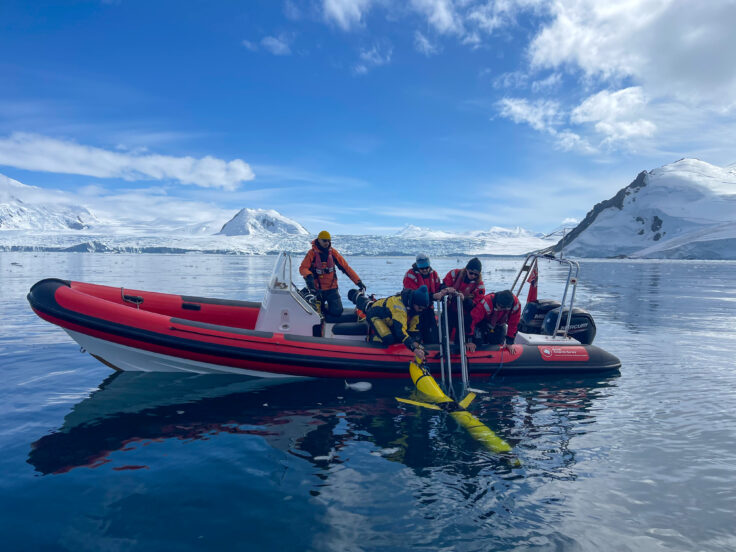
The British Antarctic Survey uses underwater gliders equipped with sensors to measure temperature, salinity, ocean circulation, and nutrient transport. This equipment alters its own buoyancy to dive and surface, moving forward slowly without a propeller. Upon reaching the surface, they receive new instructions and transmit data via satellite.
In Ryder Bay, near Rothera Station, the gliders monitor the water mixing caused by ice calving. The phenomenon produces internal waves capable of transporting heat, nutrients, and carbon through the water column. A ship can identify the event; the robots remain in the region to observe it with higher resolution and for longer periods.
Instruments where people cannot reach
In Greenland, the GIANT project combines nine autonomous systems to study how fjord glaciers react to a warmer ocean. Among them is the Meltstake, a platform with cameras, hydrophones, and acoustic sensors that can be fixed directly to the submerged wall of a glacier. It measures melting in a position too risky for divers or crewed vessels.
Other vehicles monitor animals. On Signy Island, a drone installed at an automated station can take off, map the terrain, and count penguin nests even when the research station is unstaffed. In South Georgia, small sail- and solar-powered vessels track krill for months with low fuel consumption.
Less fuel and longer observations
Fixed-wing drones are also beginning to replace part of the missions conducted by airplanes. Smaller sensors and more capable aircraft make it possible to map geological structures beneath the ice with a fraction of the fuel and logistics previously required. This frees up crewed aircraft for operations that truly require people or heavy instruments.
Autonomy does not eliminate human work. Scientists still need to frame questions, calibrate sensors, interpret data, and perform field activities that machines cannot do. The transformation lies in combining satellites, ships, teams on the ice, and robots that fill observation gaps.
Artificial intelligence as a coordinator
As the number of platforms grows, artificial intelligence will be able to point out regions with greater scientific uncertainty, integrate measurements, and adapt routes in near real-time. The expected result is a more persistent, efficient, and secure polar network—essential for tracking rapidly changing glaciers, oceans, and ecosystems.
Source
Featured image: Athena Dinar/British Antarctic Survey.