
Greenhouse gases trapped in 3,000-year-old Antarctic ice are being extracted and analyzed by scientists in Australia. The goal is to find crucial clues about Earth’s climate past. The analyzed carbon dioxide (CO2), methane, and nitrous oxide were trapped as snow gradually compressed into ice, about one hundred meters below the surface of East Antarctica.
This gas analysis represents a new phase following two consecutive successful drilling seasons by Australia’s Million Year Ice Core (MYIC) project. To date, researchers have managed to recover ice samples dating back to the end of the last ice age, 13,100 years ago. In upcoming seasons, the MYIC team plans to go much further, seeking to extract ice containing a climate record exceeding one million years, directly from the drilling site at Dome C North, near Australia’s Casey research station.
The Million Year Ice Core Project and the quest for the past
The MYIC project is one of the most ambitious scientific initiatives currently underway on the frozen continent. By analyzing ancient air preserved deep within the ice sheet, scientists hope to reconstruct Earth’s atmosphere from periods long before recorded human history.
Gas analysts Dr. Daniel Baggenstos, from the Australian Antarctic Division (AAD), and Dr. Andy Menking, from the Australian Antarctic Program Partnership (AAPP), are leading the development of two distinct methodologies to measure these gases in a specially built laboratory at the Institute for Marine and Antarctic Studies (IMAS).
“Ice cores are amazing for studying greenhouse gases because they preserve air extremely well inside bubbles, which allows us to directly study the ancient atmosphere,” explained Dr. Baggenstos. He points out that science already has a good understanding of what will be found in the first 800,000 years of the record, as this timeframe has already been measured in other ice cores around the continent. However, the period prior to this limit represents, according to the researcher, “uncharted waters.”
Innovative analysis methods: Sublimation and Continuous Flow
To decipher the secrets kept in the ice, researchers developed two complementary techniques. The first focuses on measuring gas concentrations at discrete points in time, while the second performs continuous analysis along the ice cores.
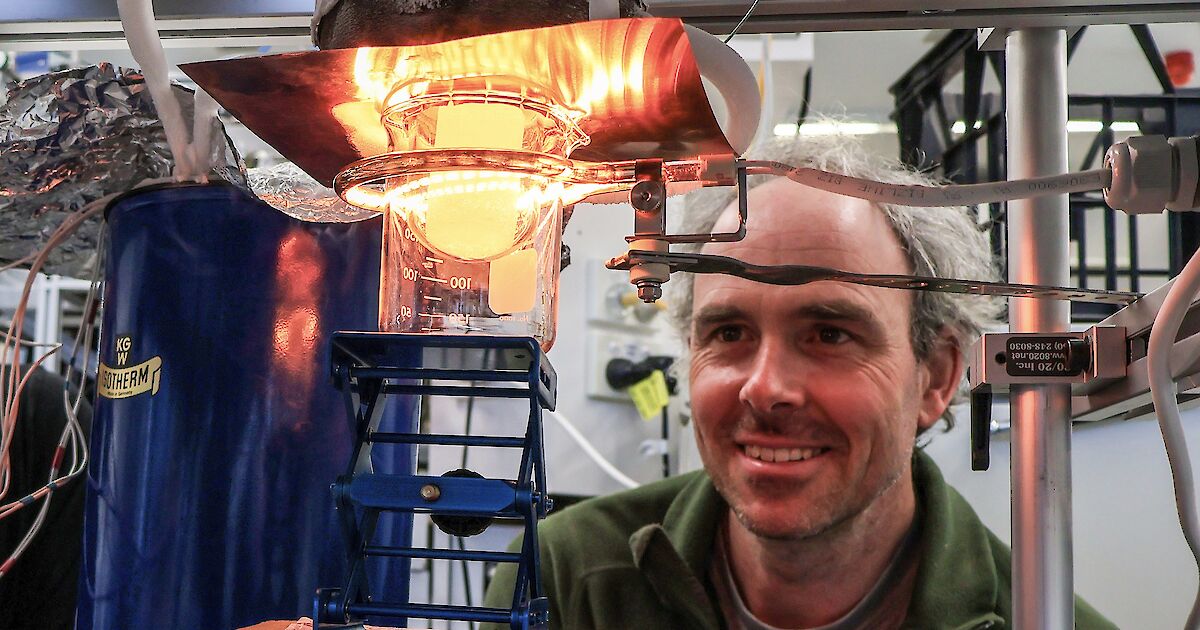
For measurements at specific points in time, Dr. Baggenstos uses a physical process called sublimation, which allows the release of trapped gases without melting the ice. The procedure consists of placing a five-centimeter ice sample, weighing around 50 grams, inside a vacuum chamber. Under low-pressure conditions, the sample is heated by a heat lamp, causing the ice to pass directly from a solid to a gaseous state (water vapor).
During this process, atmospheric gases trapped in the air bubbles are released. Water vapor rises and condenses on a cooling ring, where it freezes again. Meanwhile, greenhouse gases, which freeze at much lower temperatures, remain in a gaseous state and are captured in a thin metal tube. According to Baggenstos, this process takes about 90 minutes and generates four to five milliliters of air from 50 grams of ice, a volume sufficient to perform all necessary analyses using an absorption spectrometer, which measures the concentration of each gas by detecting the amount of light absorbed at specific wavelengths.
The team plans to analyze at least one ice sample for every 1,000 years of history. However, as samples get deeper, annual ice layers are compressed into extremely thin bands, meaning a single five-centimeter sample can represent hundreds of years of atmospheric history.
To overcome this limitation and speed up the process, the second method comes into play: continuous flow analysis. Developed to measure concentrations uninterruptedly along the core, this technique promises to analyze about 20 meters of ice per day.
“We expect the continuous flow analysis method to allow us to measure about 20 meters of ice per day, and it can better resolve variations in gas concentrations, especially in deeper ice where the layers are very thin,” highlighted Dr. Andy Menking.
Unlike sublimation, the continuous flow method melts the ice in a controlled manner. Thin one-meter-long strips of ice are melted vertically, ensuring that water and air are released in the exact chronological order in which they were formed and trapped. However, this technique measures methane exclusively, as other greenhouse gases end up dissolving in water during melting. The flow of water and air passes through a series of tubes that separate the bubbles from the liquid, directing the gas stream straight to a laser spectrometer.
The mystery of the ice age cycle transition
The search for a climate record extending back over a million years aims to solve one of modern climatology’s greatest mysteries: the shift in the pace of Earth’s ice age cycles, which occurred about a million years ago.
Before this transition, ice ages occurred in cycles of approximately 40,000 years. After this period, the interval between glaciations increased to roughly 100,000 years, making ice ages longer and more intense. The leading scientific hypothesis to explain this shift points to a gradual decline in carbon dioxide (CO2) levels in Earth’s atmosphere.
The detailed study of methane also plays a crucial role in this investigation. “We’re really curious about the relationship between climate and methane, and the natural fluctuations of the gas before humans made an impact,” said Dr. Menking. He questions whether, during the glacial cycle transition, methane followed its usual patterns of rise and fall or if there was some kind of decoupling.
Additionally, methane is a gas of major interest for current climate policy due to its short lifetime in the atmosphere, meaning human actions in agriculture or industry could quickly reduce its global concentration. Scientists also use methane to date air bubbles in ice cores by cross-referencing its concentration data with other known global records.
Next steps and future goals
The team of Australian scientists anticipates that gas processing and analysis will be fully operational before the start of the next drilling season in Antarctica, scheduled for December. This upcoming field stage aims to drill down to a depth of 1,000 meters, retrieving more ice for the project. The ultimate long-term goal is for drilling to reach the bedrock of the ice sheet, at an estimated depth of 3,000 meters, between the 2029 and 2030 seasons.
“It’s going to be really exciting to measure something that no one has measured before and produce data that contributes to our understanding of the climate system,” concluded Dr. Baggenstos.