
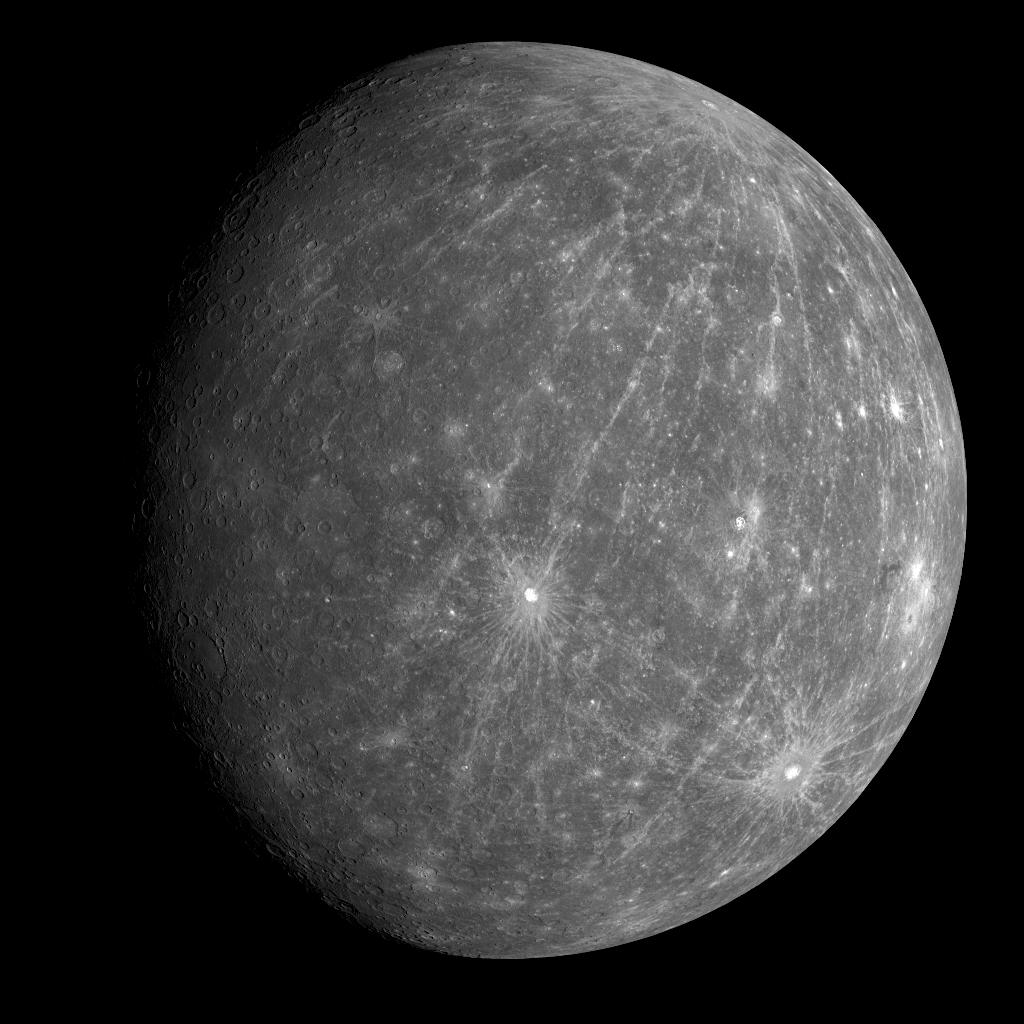
Mercury may have shrunk 10% to 30% more than previous estimates indicated, according to a new study published in Geophysical Research Letters. The revision suggests that the smallest planet in the Solar System has lost as much as 23 kilometers (14.5 miles) from its diameter since it formed about 4.5 billion years ago.
The contraction is not a sudden event. As Mercury lost heat left over from its formation, its interior slowly cooled and contracted. The crust responded by forming scarps, ridges and other wrinkle-like structures that scientists use to calculate how much the planet has shrunk over geologic time.
Impact debris concealed part of the evidence
The team led by planetary scientist Gaku Nishiyama of the German Aerospace Center compared maps of contraction structures with a new global map of surface roughness. The researchers found that the roughest areas showed fewer visible signs of shortening.
The proposed explanation is that craters and debris thrown out by impacts buried some of the scarps and ridges. Earlier surveys therefore counted only features that remained exposed. By estimating the hidden structures in rough regions, the team calculated an additional 10% to 30% contraction.
The revised value expands the earlier range of about 4 to 16 kilometers of diameter loss. The new upper estimate reaches 23 kilometers. The authors say the change brings observations closer to physical models of how Mercury cooled.
What the finding reveals
Measuring Mercury’s contraction provides an indirect way to investigate its interior. Greater shrinkage could point to a larger metallic core, a different composition with fewer light elements mixed into the metal, or a higher initial temperature.
The calculations rely mainly on data from NASA’s MESSENGER mission, which ended in 2015. Those observations can reliably identify structures larger than about five kilometers, but smaller formations may have escaped the maps. The researchers therefore say the total contraction may still be underestimated.
BepiColombo, a joint mission of the European Space Agency and Japan’s JAXA, is expected to provide sharper images and measurements during its scientific phase at Mercury. The new data could reveal smaller scarps, improve topographic maps and test the revised estimate.
The study does not mean that Mercury is rapidly shrinking today. It reconstructs a change accumulated over billions of years and shows how an impact-scarred surface can hide part of the planet’s thermal history.