

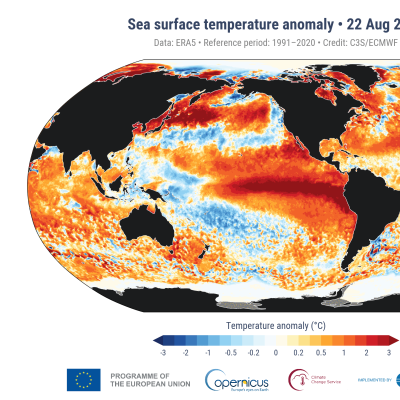
The daily average sea surface temperature outside polar regions reached 21.1 °C on August 22, 2026, the highest value in the series considered by the Copernicus Climate Change Service (C3S). The result slightly surpassed the previous record of 21.09 °C, set in March 2024.
Although the numerical difference seems small, the timing of the record catches scientists’ attention. The global average sea temperature usually reaches its highest values between March and April, after summer in the Southern Hemisphere. A peak in August indicates that the ocean remains exceptionally warm even outside this seasonal window.
What the data shows
The calculation uses the ERA5 reanalysis dataset and considers the band between 60° South and 60° North. For this comparison, Copernicus uses the most consistent part of the series, which began in 1979 with the expansion of satellite observations. In August 2023, the highest value had been 20.98 °C.
C3S links the new record to the combination of long-term warming driven by human activity and the strengthening of El Niño in the tropical Pacific. The natural phenomenon redistributes heat between the ocean and atmosphere, but currently operates on an already warmer climate base.
Why a warmer ocean matters
Warmer waters expand and contribute to sea level rise. They also increase the risk of marine heatwaves, which affect reefs, seagrass beds, food webs, fisheries, and aquaculture. A warmed ocean surface transfers more heat and moisture to the atmosphere, creating conditions capable of intensifying extreme rainfall and certain storm systems.
Another effect is the reduction in the ocean’s efficiency in absorbing carbon dioxide. As the seas retain a large portion of the climate system’s excess heat, persistent changes in this capacity can reinforce imbalances already observed.
Monitoring continues
Copernicus stresses that a daily record needs to be interpreted alongside monthly and annual trends. Still, the sequence of very warm months in 2026 and the progression of El Niño make the episode a relevant signal. Climate Pulse will continue to update measurements in near real-time.
Sources: Copernicus Climate Change Service/ECMWF and Climate Pulse.