

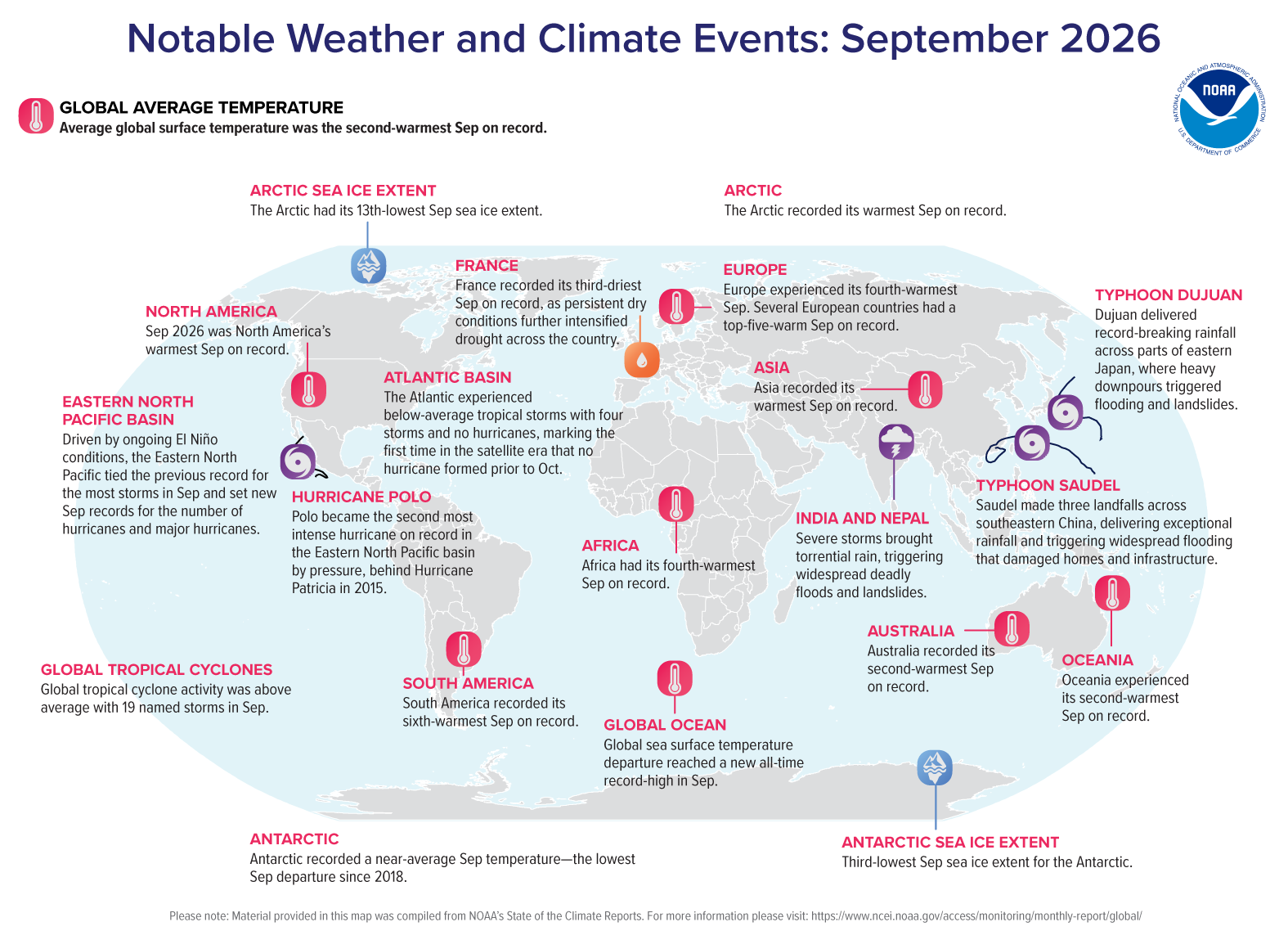
September 2026 was the second-warmest September ever recorded worldwide, while global sea surface temperatures reached an all-time monthly high. The findings were released on Friday, October 9, by the U.S. National Oceanic and Atmospheric Administration (NOAA) and independently confirmed in ranking terms by NASA’s temperature record.
According to NOAA’s National Centers for Environmental Information (NCEI), the global surface temperature was 1.33°C above the 20th-century average. The value was exceeded only by September 2023 and was 0.07°C below that record.
Oceans posted the largest monthly anomaly on record
The report’s most striking result came from the oceans. Average sea surface temperature was 1.10°C above NOAA’s historical reference. It was the largest ocean temperature anomaly measured for any month, surpassing the record set in August 2026 by 0.02°C.
September therefore became the fourth consecutive month with record-warm global oceans. The most extensive areas of exceptional warmth were concentrated in the central and eastern tropical Pacific amid El Niño, as well as parts of the Atlantic, Indian and Southern oceans.
Ocean measurements matter because the seas absorb much of the excess heat in the climate system. Higher temperatures can increase evaporation, intensify marine heatwaves and influence rainfall patterns and the energy available to storms. Attributing any individual event, however, requires a dedicated analysis and cannot be inferred from a global monthly average alone.
NASA confirms the ranking
NASA’s GISTEMP analysis, produced by the Goddard Institute for Space Studies, was also updated through September. In the agency’s dataset, which uses 1951–1980 as its reference period, September 2026 had an anomaly of 1.38°C. It ranked behind only September 2023, at 1.48°C.
NASA and NOAA’s absolute figures should not be compared directly because the agencies use different reference periods and methods. Their agreement on the ranking, however, reinforces the conclusion that September 2026 was the second-warmest September in the global records.
Heat over land and in the polar regions
Across land areas, average temperature was 1.83°C above NOAA’s reference, the third-highest September value in the 177-year record. Parts of North America, Europe, western Asia, Australia and western Antarctica experienced departures above 2°C.
The Arctic, North America and Asia each recorded their warmest September. NOAA also reported that this was the 51st consecutive September with a global temperature above the 20th-century average and that all ten of the warmest Septembers have occurred since 2015.
Sea ice below average in both hemispheres
Combined global sea ice extent was the third-smallest for September in 48 years of satellite observations. Coverage was 800,000 square miles — about 2.1 million square kilometers — below the 1991–2020 average.
The Arctic recorded its 13th-lowest September extent, while Antarctica had its third-smallest coverage for the month. The results show that sea ice in both polar regions remained below the historical norm, even though seasonal and weather processes differ between the two hemispheres.
Cyclone activity was also above average
The report counted 19 tropical storms worldwide during September, six of which reached major intensity. The eastern North Pacific recorded eight storms; seven became hurricanes and five reached major hurricane strength, both basin records for September.
The Atlantic, by contrast, had four tropical storms and no hurricanes during September. According to NOAA, it was the first time in the satellite era that the Atlantic season reached October without producing a hurricane.
2026 is on track to rank among the warmest years
From January through September, the global average temperature in 2026 was the second-highest on record, behind only 2024. NOAA’s annual outlook indicates that 2026 is very likely to finish among the five warmest years, with the highest probability favoring second place.
A single monthly result does not by itself define a long-term climate trend. The sequence of records, persistent ocean anomalies and agreement among independent datasets, however, provide a consistent signal of an exceptionally warm planet.
Sources
- NOAA/NCEI — global temperature and precipitation monitoring for September 2026
- NASA GISS — GISTEMP v4 analysis
- NASA GISS — global monthly table updated through September 2026
Image: notable global weather and climate events in September 2026. Credit: NOAA/NCEI, U.S. government material.