
Amid the harsh conditions of the severe subantarctic winter, one of the Southern Ocean’s most emblematic ecological restoration success stories continues to yield concrete results. Scientists and rangers on Macquarie Island have resumed field inspections to assess the recolonization of the grey petrel (Procellaria cinerea), a seabird species that had completely disappeared from the island last century due to the devastating impact of predatory and herbivorous mammals introduced by human activity.
The monitoring work conducted during the winter season constitutes the first comprehensive round of surveys at the species’ nesting sites since 2018. The initiative is part of the Macquarie Island Wildlife Monitoring Program, carried out collaboratively between the Australian Antarctic Division (AAD) and the Tasmania Parks and Wildlife Service (PWS).
Unique breeding during the subantarctic winter
Unlike most seabirds inhabiting the Southern Ocean — which concentrate their breeding cycles in the milder summer months —, the grey petrel adopts an unusual biological strategy highly adapted to extreme cold. The species breeds exclusively during the winter, braving snowstorms, freezing rain, and relentless winds characteristic of subantarctic latitudes to feed and protect its chicks.
The bird’s biological cycle on Macquarie Island begins in the austral autumn, when females lay a single egg between March and April. Hatching generally occurs between May and June. From then on, the chicks remain sheltered inside underground burrows for over 100 days, during which they are fed regularly by their parents until they complete fledging and are able to fly, which happens during spring.
In addition to their direct relevance to avian biodiversity, grey petrels play a structural ecological role in the island’s terrestrial ecosystem. By hunting in the open ocean and returning to land to raise their chicks, the birds act as true bridges for marine nutrient transfer, enriching slope soil and coastal plant communities through droppings and organic remains.
History of decline and habitat restoration
Historical records show that in the early 20th century, grey petrels were widely distributed birds across Macquarie Island, although they were already considered rare around 1911. Accumulated pressure from introduced predators — such as feral cats (Felis catus) and rats — and drastic habitat alteration caused by rabbits led to the species’ complete disappearance as a breeding bird in the region over the following decades.
The first documented evidence of the grey petrel’s return occurred in 1999. The species’ return coincided directly with intensive control and subsequent complete eradication programs for feral cats, carried out by park ranger teams from the Tasmania PWS.
Subsequently, the population recovery effort gained momentum with the Macquarie Island Pest Eradication Project, a large-scale operation led jointly by the PWS and AAD that permanently eliminated invasive populations of rabbits, rats, and mice. This joint effort yielded multiple ecological benefits:
- Elimination of direct predation: The eradication of rats ended the loss of eggs and newly hatched chicks inside underground nests;
- End of competition for burrows: Without rabbits competing for burrows in the soil, petrels regained suitable areas for digging and shelter;
- Recovery of native vegetation: The absence of destructive grazing allowed dense grass tussocks (tussock vegetation) to regenerate, essential for stabilizing slopes and providing shelter from harsh weather.
Field methodology and ongoing effort
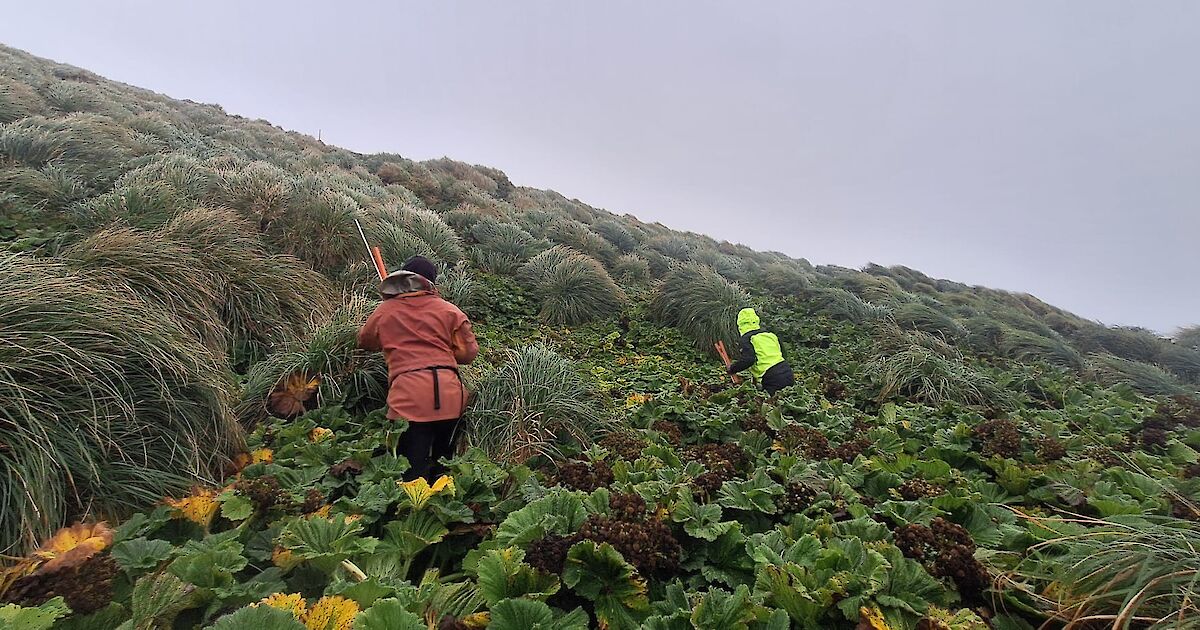
Current work on the island is carried out by a specialized team comprising Australian Antarctic Division wildlife biologist Dr. Sarah-Lena Reinhold, wildlife ranger Karina Sorrell, and ranger-in-charge Gemma Rushton. The sampling process requires high physical effort and adaptation to severe weather conditions.
To map active nests, the researchers traverse steep slopes and crawl through dense, muddy vegetation during the few hours of daylight available in winter. Burrows’ interiors are diagnosed using specialized subterranean inspection cameras (burrow scopes), allowing the team to accurately record breeding activity, verify the presence of incubating adults, and monitor the safe development of chicks without causing undue disturbance to the habitat.
The current expeditions are part of an ongoing monitoring program that will extend over the coming years. The main objective is to consolidate an updated population estimate for all of Macquarie Island, enabling grounded demographic trends to inform global conservation strategies, including commitments established under the Agreement on the Conservation of Albatrosses and Petrels (ACAP).
Global threats still present
Despite the promising scenario observed in the terrestrial sanctuary of Macquarie Island, the grey petrel remains vulnerable to significant risks when traveling in the open sea across its geographical range.
Incidental catch in commercial longline fishing historically ranks as one of the primary sources of adult seabird mortality in the Southern Ocean. In addition, global climate change is transforming oceanographic conditions and altering the spatial distribution of their prey, while marine plastic pollution poses constant risks of debris ingestion and contamination.
Experts emphasize that the success on Macquarie reinforces the effectiveness of invasive species eradication interventions on oceanic islands, but highlight that the long-term preservation of the grey petrel indispensably depends on complementary measures at sea, including the mitigation of fisheries bycatch and combating marine environmental degradation.